


Advertising seems to be blocked by your browser.
The ads help us provide this software and web site to you for free.
Please support our project by allowing our site to show ads.
Home /
Manufacturers /
AVAGO TECH. /
SAS3408-iMR /
PCI/VEN_1000&DEV_0017&SUBSYS_DA1319E5 /
7.715.04.00 Sep 01, 2020
AVAGO TECH. SAS3408-iMR how to download and install the driver
SAS3408-iMR is a SCSI Adapter hardware device. The developer of this driver was AVAGO TECH.. The hardware id of this driver is PCI/VEN_1000&DEV_0017&SUBSYS_DA1319E5.
1. AVAGO TECH. SAS3408-iMR - install the driver manually
- Download the driver setup file for AVAGO TECH. SAS3408-iMR driver from the location below. This download link is for the driver version 7.715.04.00 dated 2020-09-01.
- Start the driver setup file from a Windows account with the highest privileges (rights). If your UAC (User Access Control) is running then you will have to accept of the driver and run the setup with administrative rights.
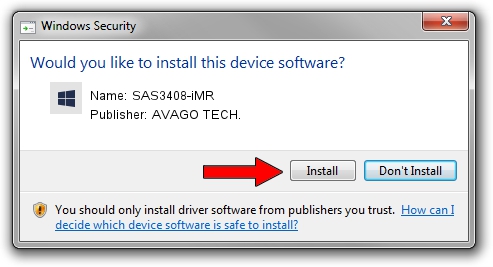
- Go through the driver installation wizard, which should be pretty easy to follow. The driver installation wizard will scan your PC for compatible devices and will install the driver.
- Restart your computer and enjoy the updated driver, it is as simple as that.
File size of the driver: 83722 bytes (81.76 KB)
This driver was rated with an average of 4.2 stars by 18583 users.
This driver will work for the following versions of Windows:
- This driver works on Windows 10 64 bits
- This driver works on Windows 11 64 bits
2. How to install AVAGO TECH. SAS3408-iMR driver using DriverMax
The advantage of using DriverMax is that it will install the driver for you in the easiest possible way and it will keep each driver up to date. How can you install a driver with DriverMax? Let's take a look!
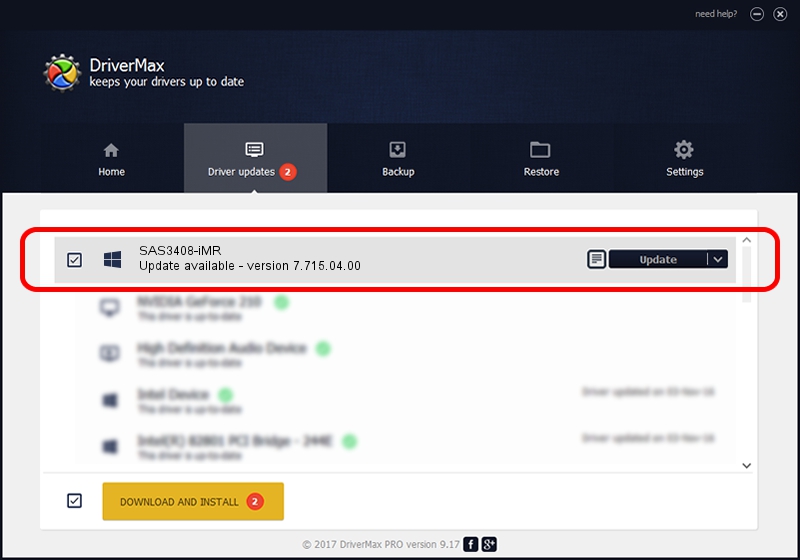
- Open DriverMax and press on the yellow button named ~SCAN FOR DRIVER UPDATES NOW~. Wait for DriverMax to analyze each driver on your computer.
- Take a look at the list of driver updates. Search the list until you find the AVAGO TECH. SAS3408-iMR driver. Click on Update.
- That's all, the driver is now installed!

Aug 5 2024 3:19AM / Written by Dan Armano for DriverMax
follow @danarm